A car that struggles to start makes most drivers think one thing: “I need a new battery.”
Sometimes that is true. But if your car battery keeps dying, the battery is often the victim, not the cause. A loose or corroded connection, a charging system that is not doing its job, an electrical component that keeps drawing power after you lock the car, or a driving pattern of short trips can all leave a perfectly good battery flat again and again.
This guide walks through the common causes, the simple tests you can do at home with an inexpensive multimeter, and how to decide whether you really need a new battery before you spend money on one.
Quick Answer
If your car battery keeps dying, check these things in order: (1) clean, tight battery terminals, (2) the battery’s resting voltage and age, (3) the charging voltage with the engine running, and (4) whether something is draining power while the car is parked. A fully charged 12-volt battery usually rests at about 12.6 volts, and a healthy charging system typically shows roughly 13.5 to 14.7 volts with the engine running. If the battery dies after sitting overnight but tests fine once charged, a parasitic drain is the most likely suspect.
Why Does a Car Battery Keep Dying? 7 Common Causes
A healthy battery should start your car day after day. When it keeps going dead, something is either preventing it from recharging properly or draining it faster than normal. These are the most common reasons.
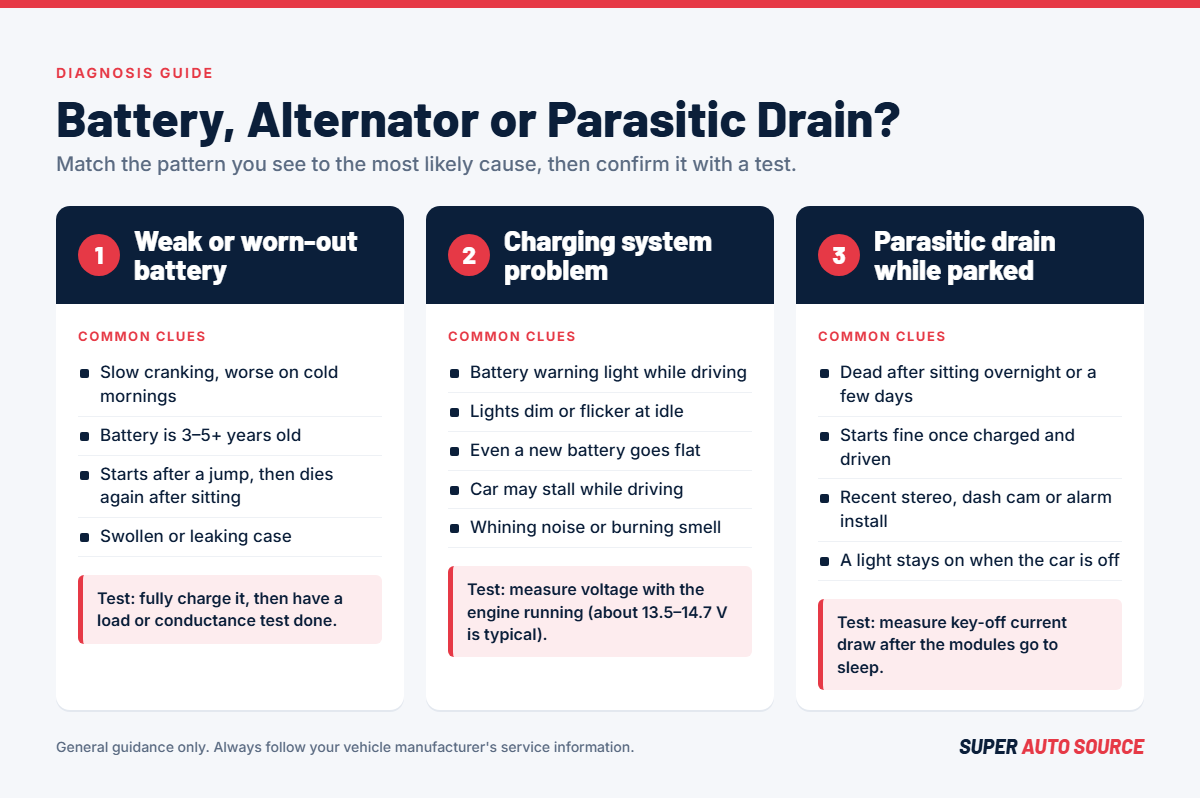
1. The Battery Is Old or Worn Out
Car batteries are wear items. According to AAA, a typical car battery lasts about three to five years, and batteries in hot climates tend to sit at the shorter end of that range. As a battery ages, its ability to store and deliver energy gradually drops, so it may start the car one day and struggle the next.
Signs of an aging battery include:
- Slow, labored engine cranking
- Dim headlights at startup
- A clicking sound when you turn the key or press the start button
- Needing jump-starts more and more often
- Electrical accessories acting strangely during starting
Age alone does not prove the battery is bad, but a battery older than three years that keeps going flat should be tested before you look elsewhere.
2. Corroded or Loose Battery Connections
Look at the battery terminals. White, blue or greenish crusty buildup around the posts and clamps can block the flow of current. A clamp that is even slightly loose can cause the same symptoms. A poor connection can also stop the alternator from fully recharging the battery while you drive.
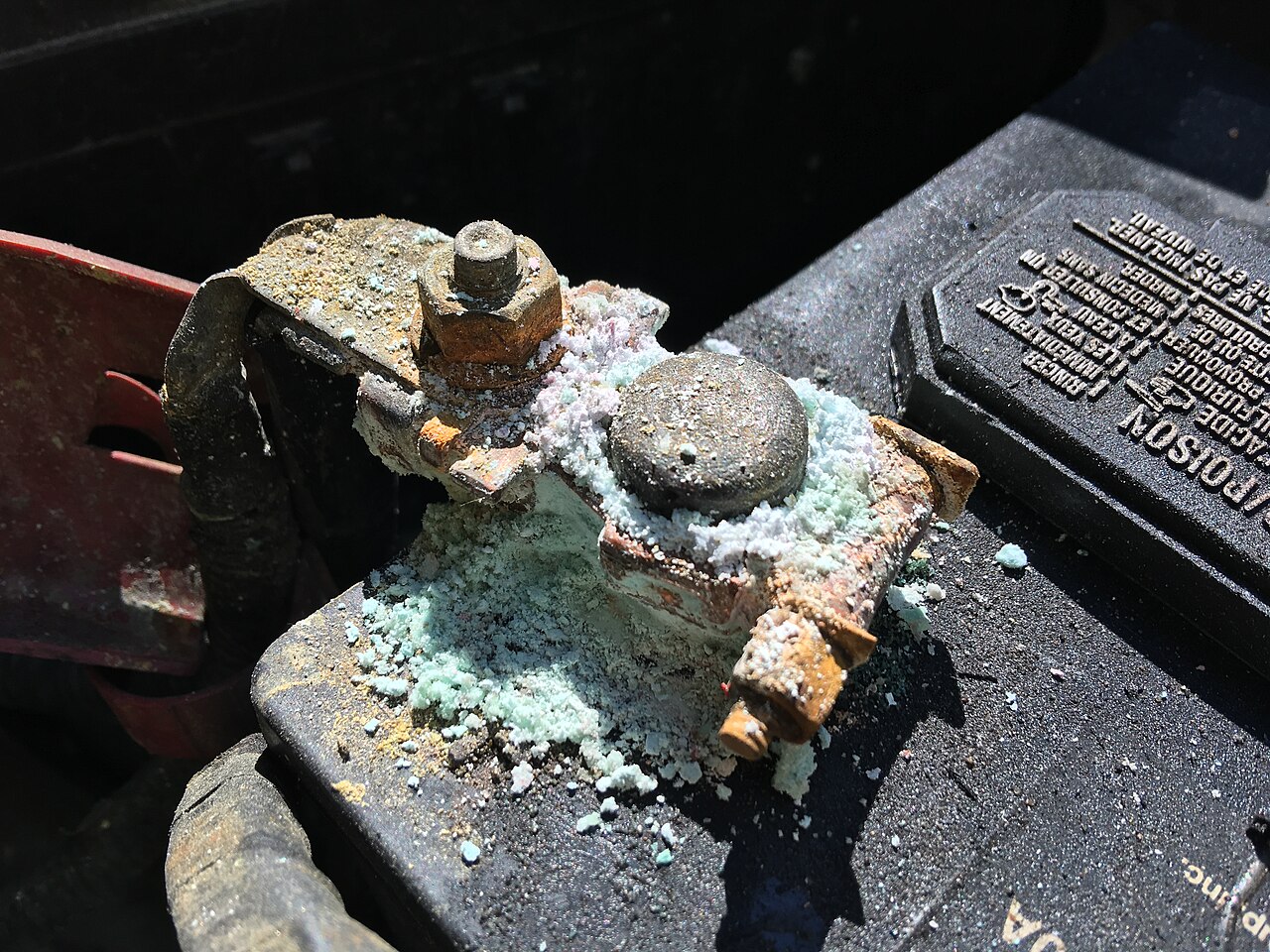
With the engine off, check that both cables are tight and the clamps do not twist on the posts by hand. If you clean the terminals, disconnect the negative (–) cable first and reconnect it last, use a terminal brush with a baking soda and water solution, and wear eye and hand protection. Battery residue is corrosive.
3. The Alternator or Charging System Is Not Recharging the Battery
The battery supplies the burst of power needed to start the engine. Once the engine is running, the alternator takes over, powering the car’s electrical systems and recharging the battery. If the alternator, its drive belt, or the wiring between them has a problem, the battery slowly drains while you drive, even if the battery itself is new.
Possible signs of a charging-system problem include:
- A battery or charging warning light on the dashboard
- Headlights that dim or flicker, especially at idle
- A whining noise or burning smell from the engine bay
- Electrical accessories behaving inconsistently
- A new battery that still goes flat
- The engine stalling while driving
If you keep recharging or replacing the battery and the problem keeps coming back, the charging system deserves a test.
4. Something Is Draining the Battery While the Car Is Parked
Every modern car uses a small amount of power when it is switched off to keep the clock, radio presets, security system and computer memory alive. This is called parasitic draw, and a small amount is normal. The problem starts when a component keeps drawing much more current than it should.
Common culprits include:
- A glovebox, trunk or vanity mirror light that stays on
- A door that is not fully latched, keeping interior lights or modules awake
- An aftermarket stereo, amplifier, alarm or remote starter that was wired incorrectly
- A dash camera with parking mode
- Phone chargers or accessories left plugged into an always-on power outlet
- A relay or control module that does not shut off
If the battery dies after the car sits overnight or for a few days, but starts fine once charged and driven, a parasitic drain is a strong possibility. The test for it is explained below.
5. You Do Not Drive Often Enough, or Only Take Short Trips
A battery naturally loses some charge over time, and the car’s normal key-off draw adds to that loss. A vehicle that sits for a week or more can end up too weak to start.
Short trips cause a similar problem. Starting the engine takes a big chunk of energy, and a five-minute drive is often not long enough for the alternator to put it all back. Repeat that pattern for a few weeks and the battery stays partly discharged, which also shortens its life.
If you rarely drive a vehicle, a quality battery maintainer (a smart charger designed to be left connected) can keep the battery topped up safely. Choose one that matches your battery type, and follow its instructions.
6. Extreme Heat or Cold
Temperature has a big effect on batteries. Cold weather slows the chemical reaction inside the battery, which reduces the power it can deliver, while thick cold engine oil makes the engine harder to crank. That is why weak batteries often fail on the first cold morning of the year.
Heat is less obvious but just as harmful. AAA notes that heat speeds up battery degradation, and under-hood temperatures in hot weather can be very high. A battery that was weakened during summer often fails when winter arrives.
7. You Left Something On
It sounds obvious, but headlights, interior lights, an accessory left in the on position, or a hatch that did not fully close can drain a battery in a few hours. Many newer cars shut these off automatically after a while, but not every system is covered. If the battery died once after an obvious mistake and the car has been fine since, the battery may need a full recharge and a test rather than a replacement.
How to Test Your Car Battery at Home
A basic digital multimeter costs little and can tell you a lot. Set it to DC volts (the 20 V range if it is not auto-ranging), and follow these steps.
Step 1: Check the resting voltage
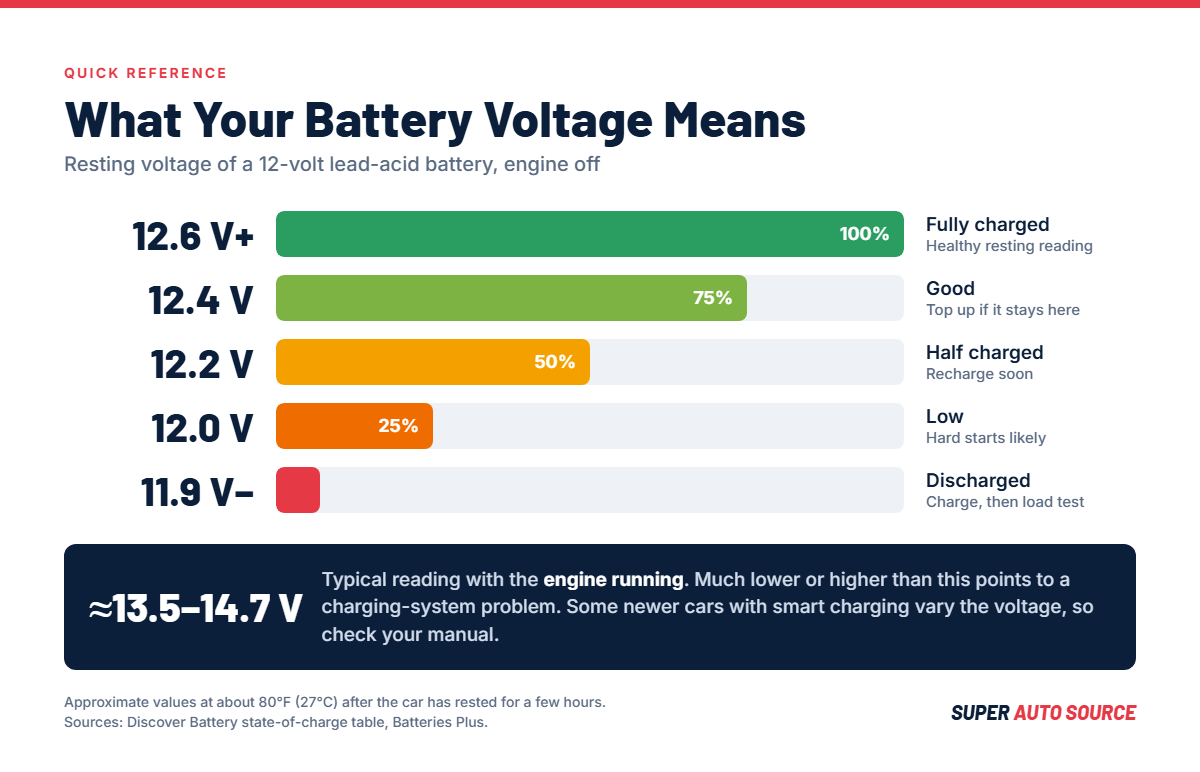
Let the car sit with the engine off for a few hours, ideally overnight, so any surface charge from driving fades. Then touch the red probe to the positive (+) terminal and the black probe to the negative (–) terminal.
| Resting voltage | Approximate state of charge | What it means |
|---|---|---|
| 12.6 V or higher | 100% | Fully charged |
| About 12.4 V | 75% | Good, but could use a top-up |
| About 12.2 V | 50% | Recharge soon |
| About 12.0 V | 25% | Low, hard starts likely |
| 11.9 V or lower | Discharged | Recharge, then load test |
These figures come from the state-of-charge table published by Discover Battery and are based on a battery at about 80°F (27°C). Exact numbers vary slightly by battery type and temperature.
Step 2: Check the charging voltage
Start the engine and measure across the battery terminals again. A working charging system typically reads about 13.5 to 14.7 volts, as Batteries Plus explains. A reading that stays near battery voltage (around 12.5 volts or lower) suggests the alternator is not charging. A reading well above the normal range can mean a voltage regulator problem, which can damage the battery.
Note: some newer vehicles use “smart” charging systems that deliberately vary the voltage to save fuel, so a lower reading at certain moments is not always a fault. If your car has a start-stop system or you see unusual readings, check the owner’s manual or have the system scanned.
Step 3: Have a load or conductance test done
Voltage alone shows how charged the battery is, not how healthy it is. A battery can read 12.6 volts and still fail under load. After fully charging the battery, have it load-tested or conductance-tested. Many auto parts stores and repair shops can do this, often for free. During cranking, a healthy battery generally stays above about 10 volts.
How to Check for a Parasitic Drain
If the battery tests good but still dies while parked, measure how much current the car draws with everything switched off. This test involves putting the multimeter in series with the battery, so take your time and follow the meter’s instructions.
- Turn off the engine, lights and all accessories, remove the key, and close all the doors. If you need the hood or a door open, latch it manually so the car thinks it is closed.
- Set the multimeter to DC amps and move the red lead to the 10 A (or 10 A fused) jack.
- Disconnect the negative battery cable. Connect one meter lead to the negative battery post and the other to the disconnected cable, so all current flows through the meter.
- Wait for the car’s computer modules to go to sleep. Fluke says this usually takes about 10 to 45 minutes depending on the vehicle.
- Read the current. Fluke considers under about 50 milliamps (0.05 A) normal for most vehicles after sleep, while more than 100 milliamps points to a drain worth finding. OPTIMA notes that some newer vehicles with lots of electronics can sit closer to 85 milliamps.
- If the draw is too high, pull fuses one at a time and watch the reading. When it drops sharply, you have found the circuit causing the drain.
Safety tips: never try to start the engine or switch on high-current items while the meter is connected in amps mode, because that can blow the meter’s fuse or damage it. Be aware that disconnecting the battery may reset radio presets, the clock or learned idle settings, and some vehicles require a radio code or a relearn procedure afterward. If you are not comfortable with this test, a repair shop can perform it.
Can a Battery Charger Help?
Sometimes. A charger can bring a discharged battery back to full charge, but it does not fix whatever drained it. If a parasitic drain or a weak alternator caused the problem, the battery will simply go flat again.
That is why it helps to separate two situations: “the battery is discharged” and “the battery is defective.” A discharged battery can often be recharged and tested. A defective battery will not hold a charge or will fail a load test, even after a full charge.
If your car uses an AGM or EFB battery, which is common in vehicles with start-stop systems, use a charger that has the correct setting for that battery type.
What About a Jump Starter?
A portable lithium jump starter is a useful emergency tool. Unlike jumper cables, it lets you start a compatible vehicle without a second car. When choosing one, look at:
- Compatibility with your engine size and type (gas or diesel)
- Rated starting current, not just the peak amps figure
- Built-in protection against reverse polarity and short circuits
- Cable and clamp quality
- Clear instructions from the manufacturer
If you use jumper cables instead, the usual order is: red clamp to the dead battery’s positive terminal, red to the good battery’s positive, black to the good battery’s negative, and the last black clamp to a bare, unpainted metal point on the dead car’s engine or chassis, away from the battery. Always check your owner’s manual first, since some vehicles have dedicated jump-start points.
Remember, a jump starter gets you going. It does not fix a failing battery or charging system.
When Should You Replace the Battery?
Replace the battery when testing shows it can no longer hold a charge or deliver enough starting power, especially if it is more than three to five years old. AAA recommends having the battery tested every year once it reaches its third year.
But replacing the battery without finding the real cause can mean paying twice. Think about it like this:
Old battery + healthy car:
A new battery will likely solve the problem.
New battery + weak alternator:
The new battery will go flat too.
New battery + parasitic drain:
The new battery will keep dying while parked.
When you do replace it, match the group size, terminal layout, cold cranking amps (CCA) rating and battery type listed in your owner’s manual. Some vehicles, particularly many European models, also need the new battery registered with a scan tool so the charging system adjusts correctly. After a battery change you may also need to reset a few dashboard reminders; our Nissan Rogue reset guide shows what that can involve.
How to Reduce the Chance of a Dead Battery
Drive regularly, and not only short trips
A drive of 20 minutes or more at steady speed now and then gives the alternator time to recharge the battery. If the car sits for long periods, connect a battery maintainer.
Keep the terminals clean and tight
Check them whenever you get the oil changed. Our guide on how often you actually need an oil change is a good reminder schedule for other under-hood checks too.
Do not ignore warning lights
A battery or charging light means the system needs attention now, not at the next service. The same goes for other dashboard alerts, such as a low tire pressure light, which can also show up on cold mornings.
Test the battery before winter
A quick test in the fall can reveal a weak battery before the first cold snap does.
Keep emergency gear in the car
A charged jump starter or good-quality jumper cables, a flashlight and gloves can turn a dead battery from a crisis into a short delay.
Final Thoughts
A car battery that keeps dying does not always mean you need another battery. The battery may be old, but the real cause could just as easily be a poor connection, a charging problem, a parasitic drain, short trips or extreme temperatures.
Check the connections. Test the resting voltage. Check the charging voltage. Look for anything draining power while the car is parked. A little troubleshooting now can save you from buying the wrong part and from getting stranded later.
Frequently Asked Questions
How do I know if it is my battery or my alternator?
Measure the voltage with the engine off and then running. A fully charged battery should rest around 12.6 volts, and a working charging system typically shows about 13.5 to 14.7 volts with the engine running. If the running voltage barely rises, suspect the alternator. If the charging voltage is normal but the battery fails a load test, the battery is the problem.
Why does my car battery die overnight?
The most common causes are a parasitic drain (a light, accessory or module that stays on), an old battery that can no longer hold a charge, or a poor connection. A parasitic draw test with a multimeter can confirm whether something is drawing too much current while the car is off.
What is a normal parasitic draw on a car?
After the vehicle’s modules go to sleep, most cars draw under about 50 milliamps. Some newer vehicles with many electronic features can be higher, while a draw of more than about 100 milliamps generally points to a problem.
Can a completely dead battery be recharged?
Often, yes. A discharged battery can usually be recharged with a suitable charger, but deep discharges shorten battery life. After recharging, have the battery load-tested to make sure it is still healthy.
How long should a car battery last?
Most car batteries last about three to five years. Batteries in hot climates usually wear out sooner, and frequent short trips or long periods of sitting can also shorten battery life.
Should I buy a battery charger or a jump starter?
They do different jobs. A charger or maintainer restores and maintains a battery’s charge over hours, while a jump starter is an emergency tool that gets the engine running right away. Many drivers benefit from having both.
Disclaimer: This article is for general information and is not a substitute for professional diagnosis or your vehicle manufacturer’s service instructions. Always follow the safety instructions that come with your tools and equipment.
Related guides: Oil Changes: How Often You Actually Need One · Nissan Rogue Reset Guide · How to Reset the Toyota Maintenance Required Light

1 thought on “Car Battery Keeps Dying? Don’t Buy a New Battery Yet”